
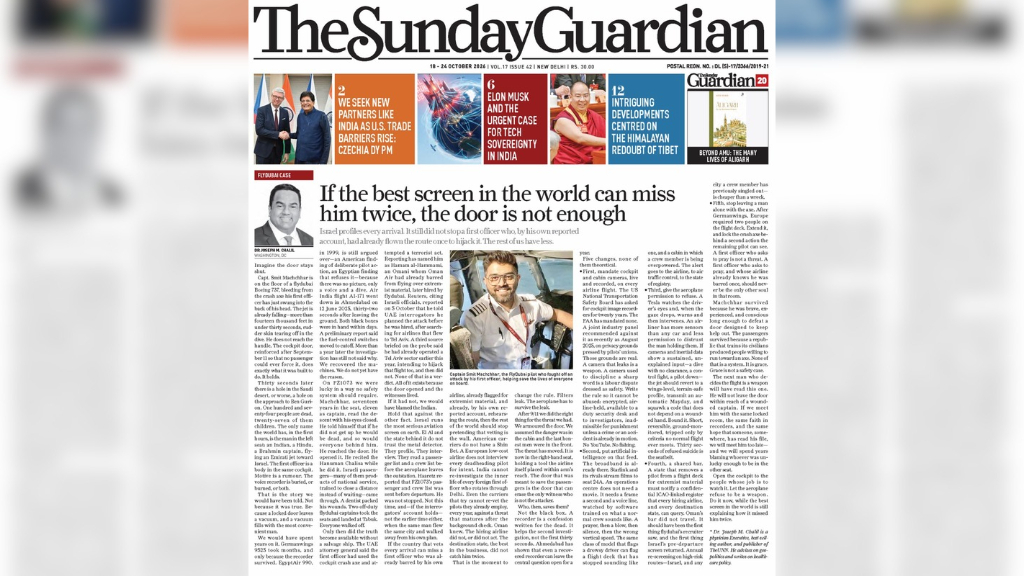
Israel profiles every arrival. It still did not stop a first officer who, by his own reported account, had already flown the route once to hijack it. The rest of us have less.
Capt. Smit Machchhar is on the floor of a flydubai Boeing 737, bleeding from the crash axe his first officer has just swung into the back of his head. The jet is already falling—more than fourteen thousand feet in under thirty seconds, rudder skin tearing off in the dive. He does not reach the handle. The cockpit door, reinforced after September 11 so that no passenger could ever force it, does exactly what it was built to do. It holds.
Thirty seconds later there is a hole in the Saudi desert, or worse, a hole on the approach to Ben Gurion. One hundred and seventy-four people are dead, twenty-seven of them children. The only name the world has, in the first hours, is the man in the left seat: an Indian, a Hindu, a Brahmin captain, flying an Emirati jet toward Israel. The first officer is a body in the same cockpit. Motive is a rumour. The voice recorder is buried, or burned, or both.
That is the story we would have been told. Not because it was true. Because a locked door leaves a vacuum, and a vacuum fills with the most convenient man.
We would have spent years on it. Germanwings 9525 took months, and only because the recorder survived. EgyptAir 990, in 1999, is still argued over—an American finding of deliberate pilot action, an Egyptian finding that refuses it—because there was no picture, only a voice and a dive. Air India flight AI-171 went down in Ahmedabad on 12 June 2025, thirty-two seconds after leaving the ground. Both black boxes were in hand within days. A preliminary report said the fuel-control switches moved to cutoff. More than a year later the investigation has still not said why. We recovered the machines. We do not yet have the reason.